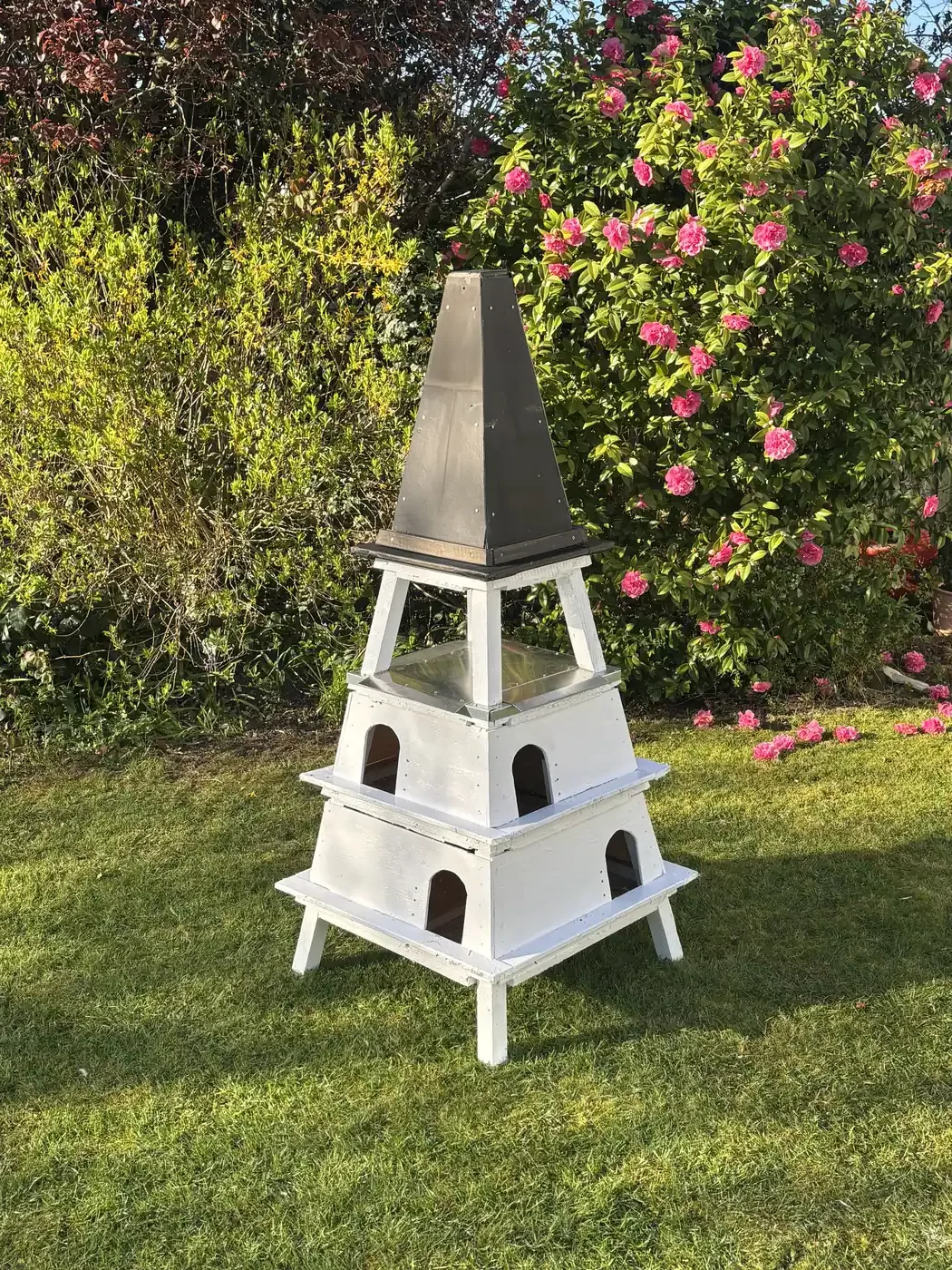
A customer project — featured on Burns Loft because Dean believes in people who take the sport seriously. Craig and Sonnie built this cote in Romford. The birds are on order. This is what it looks like when you do it properly.
Burns Loft · Dagenham · Build Diary
The Dovecote Build
White doves and racing pigeons under one roof. Craig's dovecote project — built from a salvaged frame, gifted timber and a roofer's offcuts in Romford, Essex. Birds on order from Dean Burns at Burns Loft, Dagenham. SE England, 2026.
Stage 1 — The Frame · Dagenham
Stage 01 — Foundation
A Frame from a Skip
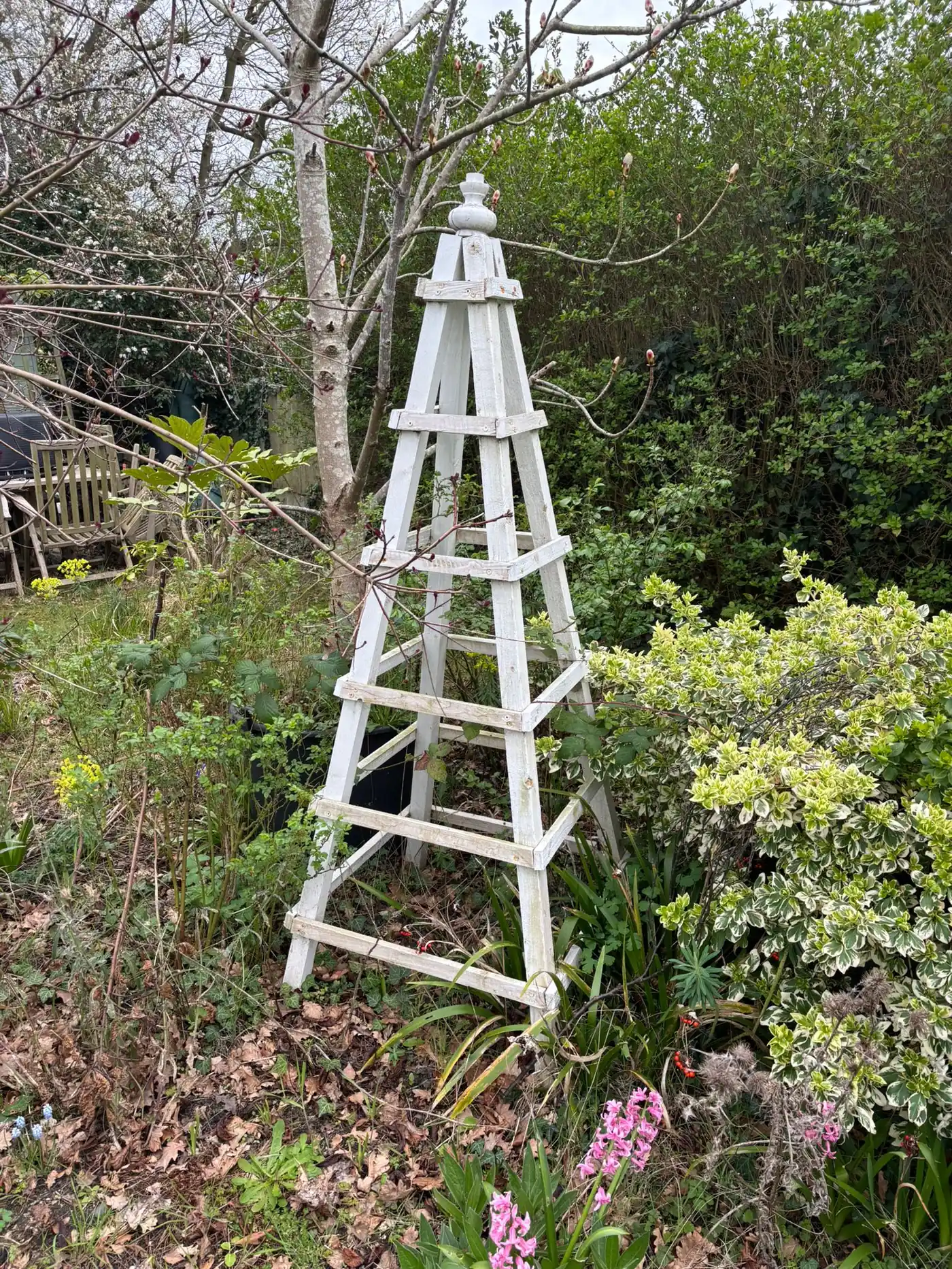
Every good build starts somewhere. This one started with a wooden obelisk — a garden ornament Craig had built for his wife the previous year, originally rescued from a skip and given a first life as a painted garden feature in Romford.
The structure was solid. The proportions were right. And with white doves planned for Burns Loft, it was the perfect starting point for something much more purposeful — a working dovecote for breeding white doves alongside the established racing pigeon operation. Now based in Romford, Essex — on the edge of East London, within reach of both communities.
Stage 2 — Floors · Gifted Ply & Timber
Stage 02 — Structure
Floors In. Gifted Timber.
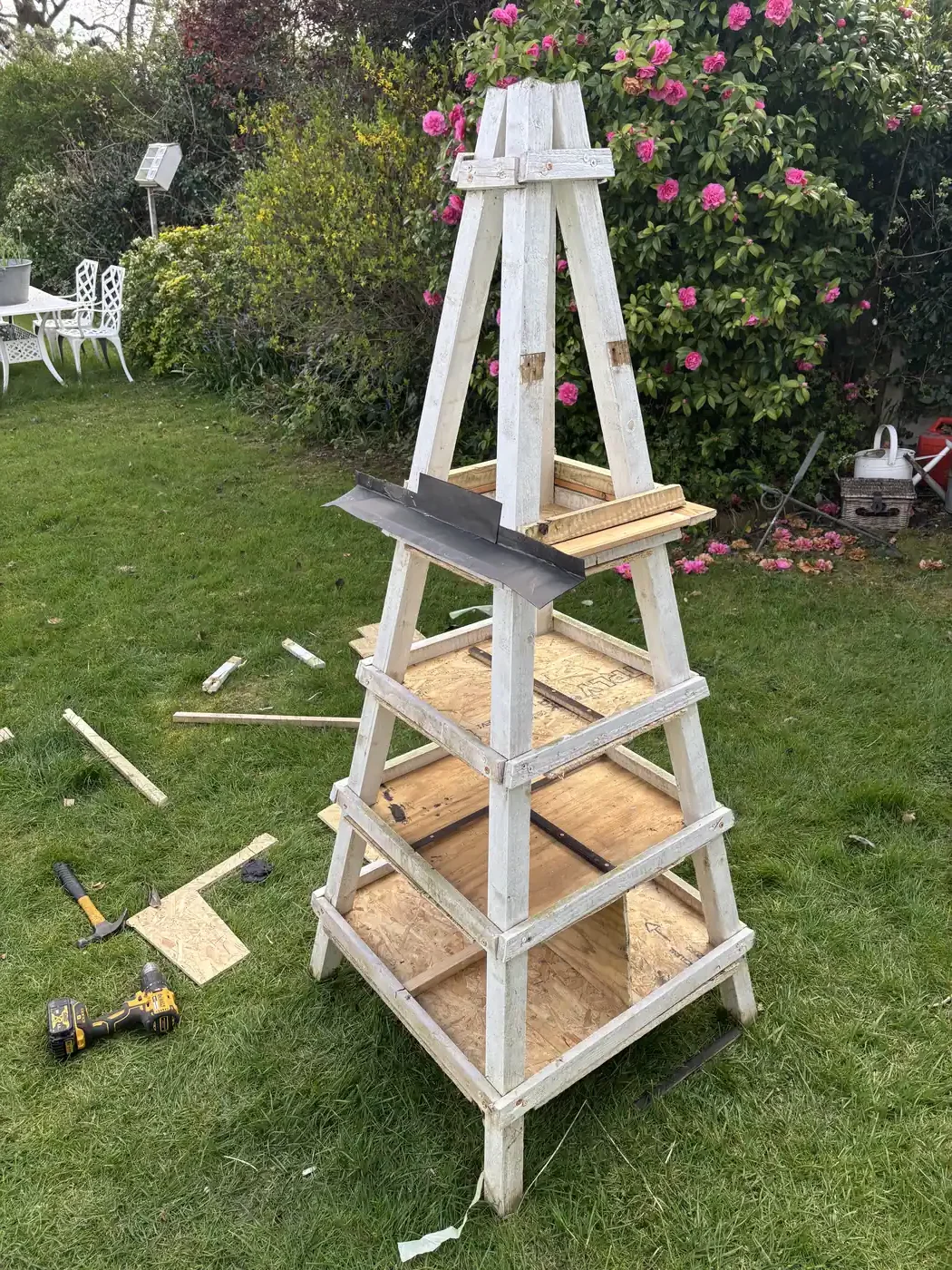
All the new timber came courtesy of Rob Albon — a Romford roofing contractor who generously donated ply board and structural timber from his yard. Quality material that would have otherwise gone to waste, put to exactly the right use. Craig is grateful for the contribution. If you're looking for a roofing contractor in Romford, Rob Albon is your man.
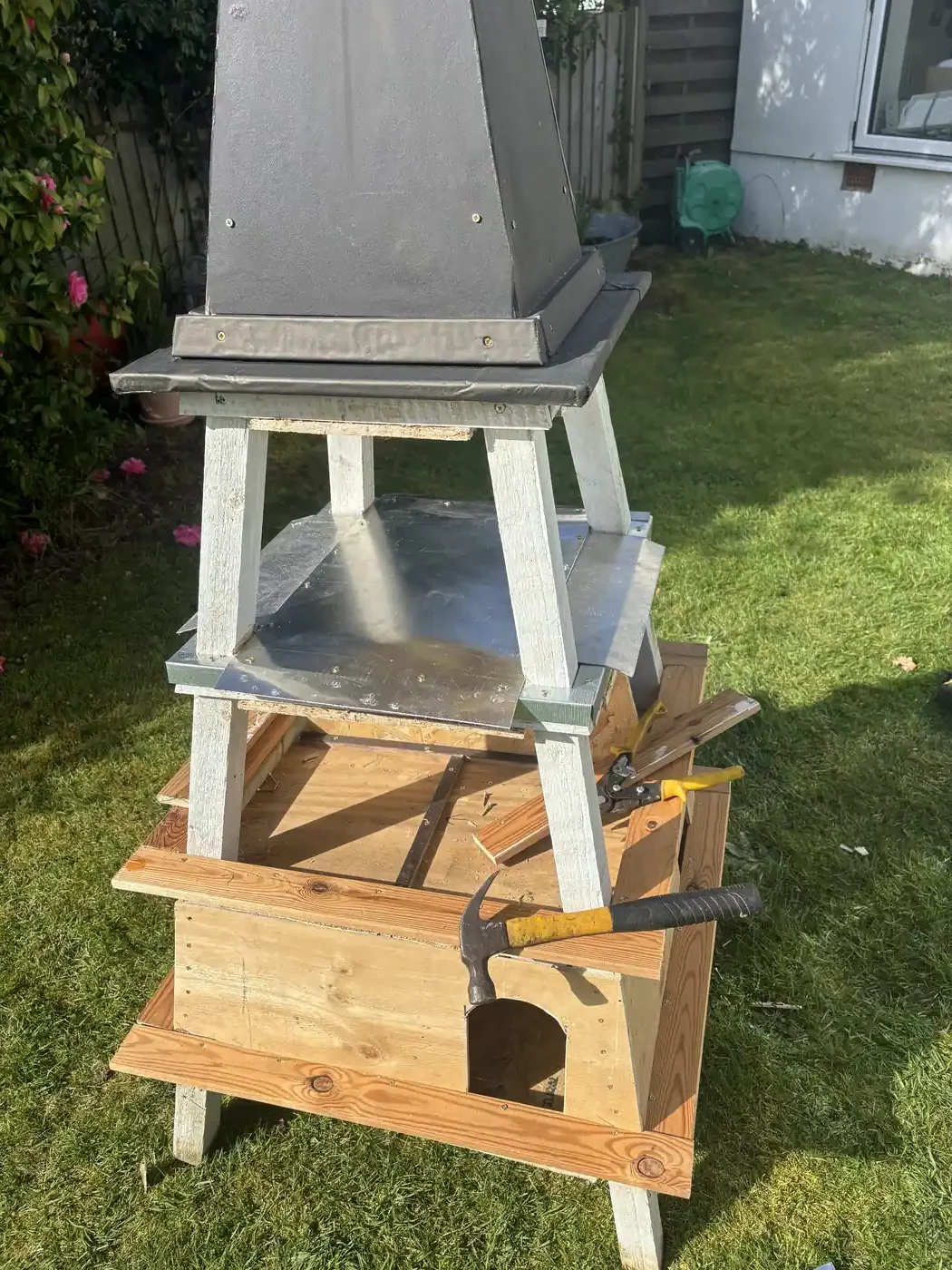
Two tiers of nesting floors were laid into the frame, creating separate levels for the breeding pairs. Multiple arched entry holes were cut into each tier, giving birds easy access while keeping the structure secure.
Stage 3 — Spire · Slate & Flashband
Stage 03 — The Spire
Slate Roof. Lead Detail.
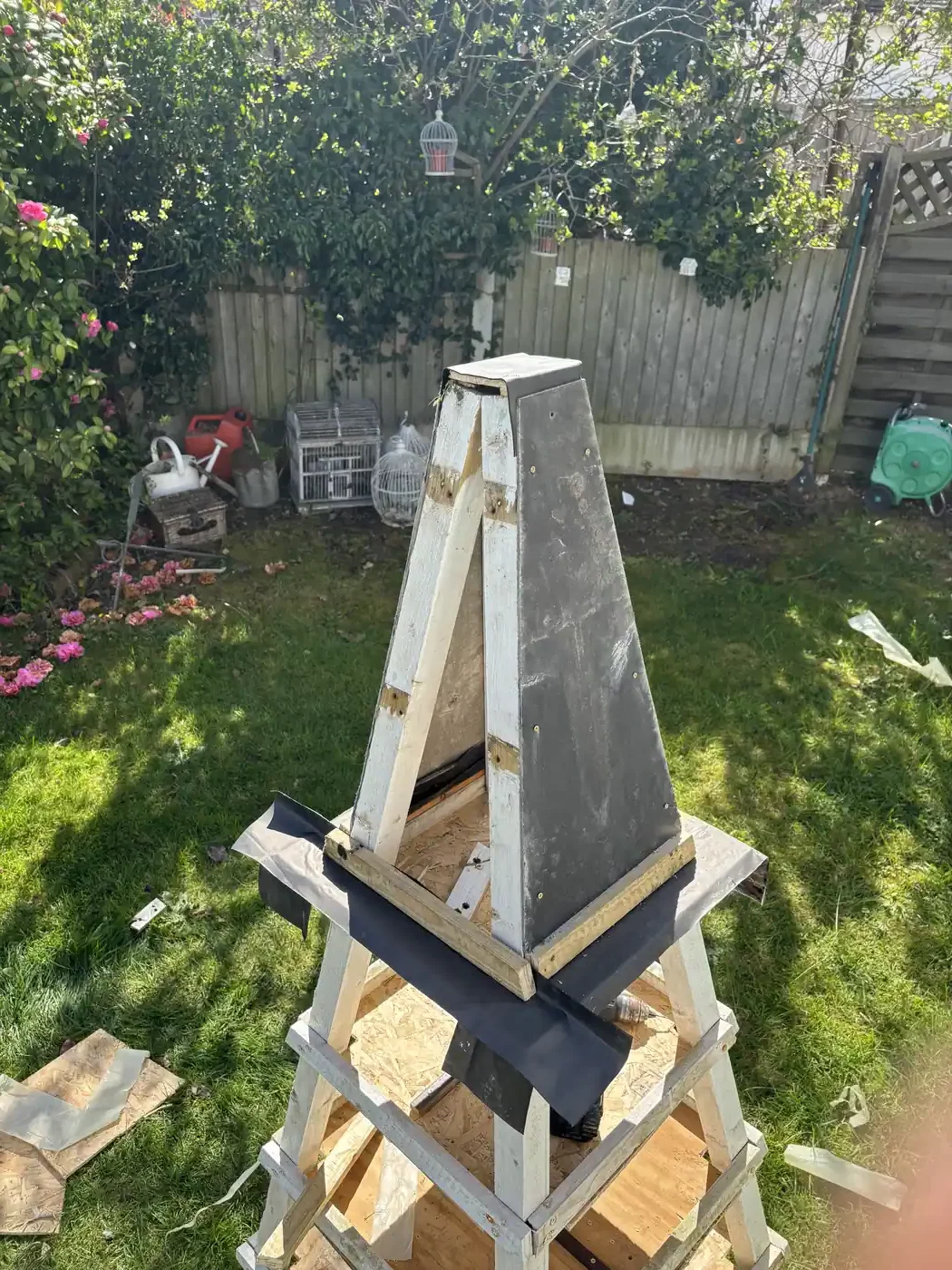
The spire was clad using slate offcuts from Rob Albon's roofing yard in Romford — the same generous source as the structural timber. Proper roofing slate, fitted to the tapered frame and shaped to a neat apex.
At the spire base, Flashband — a self-adhesive lead-effect flashing tape — was used to replicate the look of traditional leadwork, finishing the junction between slate and timber cleanly and keeping weather out. The result reads as a traditional dovecote spire without the traditional cost.
Stage 4 — Boxes & Entry Holes
Stage 04 — Nest Boxes
Sides On. Boxes Ready.
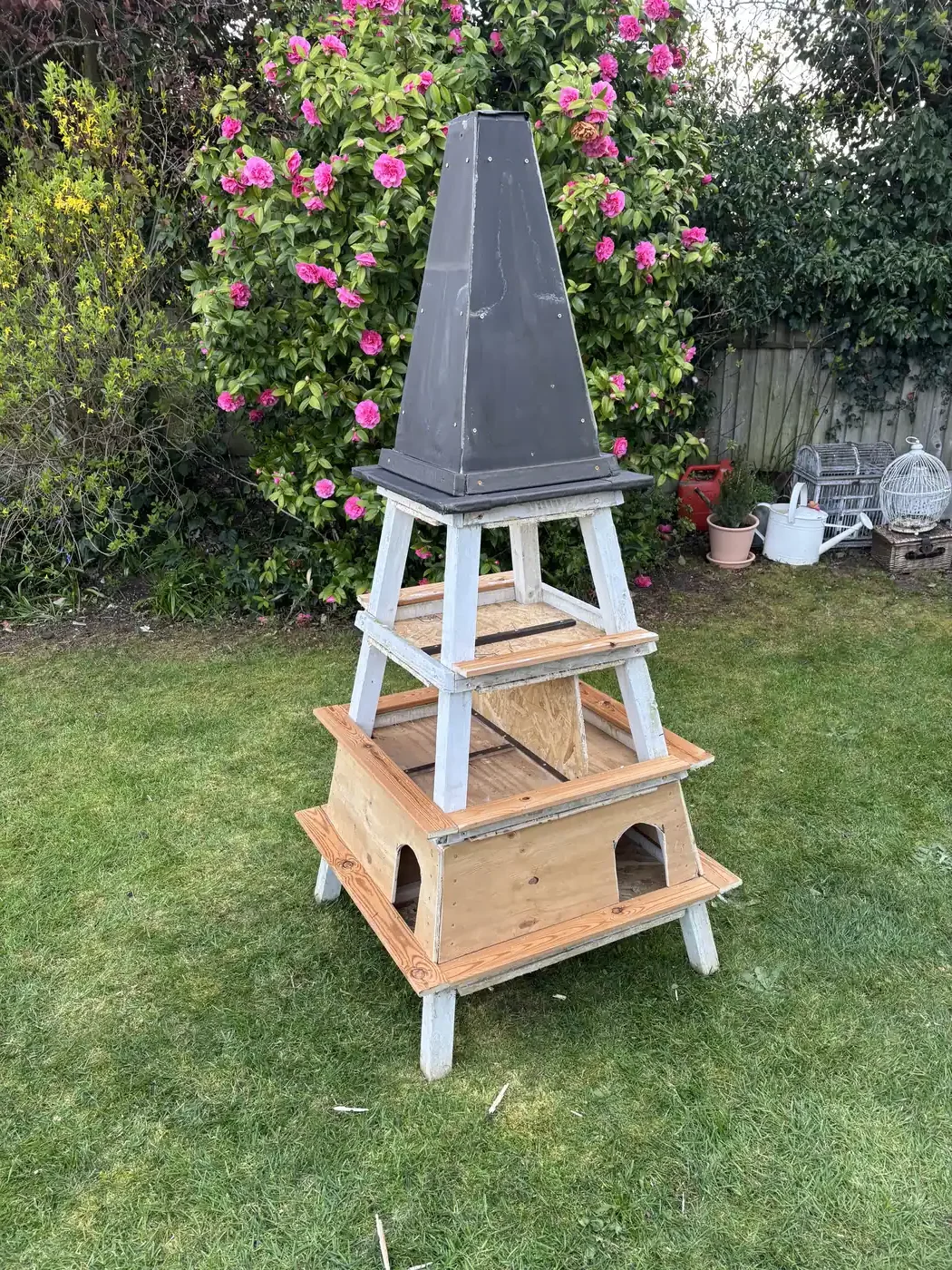
The nest boxes took shape across both tiers — solid timber sides enclosing each level, with arched entry holes cut to give the doves their own dedicated openings. The arched profile isn't just decorative — it mirrors traditional dovecote design and gives each bird a clean sightline in and out.
Two full tiers of nesting space means the cote can house multiple breeding pairs simultaneously — enough capacity for a working white dove breeding operation alongside the Burns Loft racing pigeon programme.
Stage 5 — Aluminium Platform & Roof
Stage 05 — The Platform
Sheet Aluminium. Dual Purpose.
Sheet aluminium was used to create a landing and feeding platform — the ledge where birds touch down before entering the nest boxes. Fitted to both tiers, it gives doves a clean, stable surface to land on.
The platform also doubles as a waterproof roof over the boxes below. The overhang routes rainwater clear of the timber nest boxes, keeping each level dry regardless of weather. No damp boxes. No wet birds.
Planned addition — hawk protection overhangs. Additional aluminium overhangs are being considered under the spire to further protect the doves. Birds of prey — particularly sparrowhawks and peregrines — typically attack from directly above, diving at speed. Extended overhangs reduce the bird's visual lock on a target from height and prevent a clean vertical dive. In an area with active raptors, this addition significantly improves survival odds for young birds. Nobody wants to lose doves to a hawk.
Stage 6 — Complete · Burns Loft Dagenham
Stage 06 — Complete
Painted. Ready. Waiting for Birds.
Two coats of white — traditional dovecote white — and the build is done. The slate spire, the Flashband leadwork, the aluminium platforms, the arched entry holes. From a rescued garden frame to a working dovecote, entirely from gifted and salvaged materials.
Young white doves are expected within the next few weeks — bred to order by Dean Burns at Burns Loft, Dagenham, and handed over at 28 days old. Craig and Sonnie will take it from there. Watch this page for updates as the first birds arrive and settle in.
Burns Loft · The Breeding Programme
Doves & Pigeons — What's the Difference?
Most people think of doves and pigeons as two entirely different birds. They're not. Here's the truth — and why it matters for what we're breeding at Burns Loft.
🕊
Same Family. Different Names.
Doves and pigeons both belong to the family Columbidae — over 350 species worldwide, with no scientific dividing line between them. The distinction is cultural, not biological. In French, they're all just pigeons. In English, we called the smaller, more slender birds "doves" and the stockier, larger birds "pigeons." Same bird. Different label.
Generally speaking, doves are smaller and more delicate in build — typically around 170 grams — while pigeons are larger and more robust, some varieties weighing well over 500 grams. Doves tend to have a longer, more fanned tail in flight. Pigeons often show a waxy growth at the base of the beak, called the cere, which doves lack. But these are general guides, not hard rules.
🧭
Homing Ability — The Critical Difference
This is where it matters most. True doves — Ringneck doves, the kind sold in pet shops — have no homing instinct. Release one into the wild and it cannot find its way back. It will disorientate, fail to feed itself, and in most cases die within days. Yet for years, dove release companies have sold "dove releases" at weddings and funerals using exactly these birds — with predictably tragic results for the birds.
Homing pigeons are a different matter entirely. Bred from the domestic rock pigeon, they possess an extraordinary innate navigation system — capable of returning to their loft from distances of 500 miles or more in a single day. During both World Wars, homing pigeons carried critical military messages when all other communication failed. The ability is that reliable. That precise.
📍
Range & Flight Capability
Homing pigeons are purpose-built for distance. Trained racing pigeons regularly compete over 500 miles — some exceptional birds covering 700 miles in a single flight. They navigate using a combination of the Earth's magnetic field, the position of the sun, and landmarks built up through training. The further and more frequently they're trained, the more reliable and extended their range becomes.
True doves lack this capability entirely. Their range is limited to their immediate local area, and even then, they navigate by familiarity rather than by any magnetic or solar compass. For a release bird to return safely every time, pigeon genetics are non-negotiable.
🔬
What We're Breeding at Burns Loft
The Burns Loft breeding programme is built around a deliberate cross — white doves with white homing pigeons. The goal: birds that carry the visual elegance and appearance of a dove, with the homing reliability of a trained racing pigeon. White plumage. Compact, dove-like build. Full homing instinct. Birds that can be released at a ceremony and return safely to the loft every time.
This is not guesswork. Dean Burns has over 15 years of racing pigeon breeding behind him — Van Den Bulck, Herman Ceusters, Van Lint and Pitbull bloodlines, all proven at club and federation level across SE England. That depth of knowledge is now being applied to produce release birds that actually work: birds with the look of a white dove and the navigation of a homing pigeon.
Crucially, these birds are being bred to specific requirements — not a generic production line. The breeding programme at Burns Loft is responding to exact specifications: size, temperament, plumage, homing range, and performance. If you want birds bred to your needs rather than whatever's available, this is how it's done.
Why this matters for release services: A professionally operated white dove release should only ever use birds with proven homing ability. Any release company using true doves — Ringnecks or similar — is putting birds at serious risk. At Burns Loft, every release bird will home. That's the foundation of the breeding programme.
Burns Loft · The Taming Programme
28 Days Old — Why This Date Matters
The birds won't arrive as adults. They'll come at exactly 28 days old. That date isn't arbitrary — it's the most important window in a young pigeon's life, and the entire taming plan is built around it.
📅
The 28-Day Window
At 28 days old, a young pigeon has just fledged. It's fully feathered, aware of the world, and beginning to explore — but it cannot yet fly with any real capability or confidence. Its wings are working, but its range is limited and its navigation is not yet set.
This is the precise window where imprinting on a new location — and on the people who feed it — is most effective. Introduce a young pigeon to its permanent home and the people who care for it at this age, and it will accept both as its own. The cote becomes home. The family becomes its flock. Leave it any later and the opportunity narrows fast. The bird's sense of place and self-sufficiency develops rapidly beyond 35 days, and the bond is harder to build.
Dean Burns breeds to this timeline deliberately. Handing over birds at 28 days is not convenience — it's craft.
🏠
Week One — Indoors. Hand Fed. Named.
The plan for the first week is simple and deliberate. The birds come indoors. No cote yet, no garden, no open sky. Just a quiet indoor space, regular handling, and hand feeding — twice a day, every day, from the same hands.
Alongside the feeding, two voice commands are introduced consistently from day one:
"Come on then" — said every time food is offered. The bird learns that this phrase means feed time is coming. Over days, it begins to associate the words with the approach of a hand holding food. Eventually it will fly from box to hand on that phrase alone.
"Boxes" — said when food is placed inside or near a box or nesting space. The bird learns that this word signals a return to its shelter, where food and safety wait. The word becomes the cue for home.
This is the foundation of recall training — not tricks, but practical voice commands that will serve the birds and their owner for life.
🕊
Into the Cote — Gradual Release
After the indoor bonding week, the birds move to the dovecote. Grills or mesh are used to keep them contained inside the cote initially — they can see the garden, hear the outside world, and adjust to their new home without the risk of early disorientation. Daily feeding continues with the same voice cues. The cote becomes familiar. Comfortable. Theirs.
When the grills come off, the hope is the same outcome racing pigeon fanciers aim for every time a bird is basketed for its first toss — that the pull of home, of food, of the familiar voice that means safety, is stronger than the pull of the open sky. With birds tamed from 28 days, handed food from the same people every single day, and bonded to a specific space in a garden they've watched from inside — the odds are good.
The voice commands matter here too. "Come on then" called from the garden brings a bird back to hand. "Boxes" brings it back to the cote. Two commands. Two anchors. Both built in week one.
👨👩👧👦
A Family Project
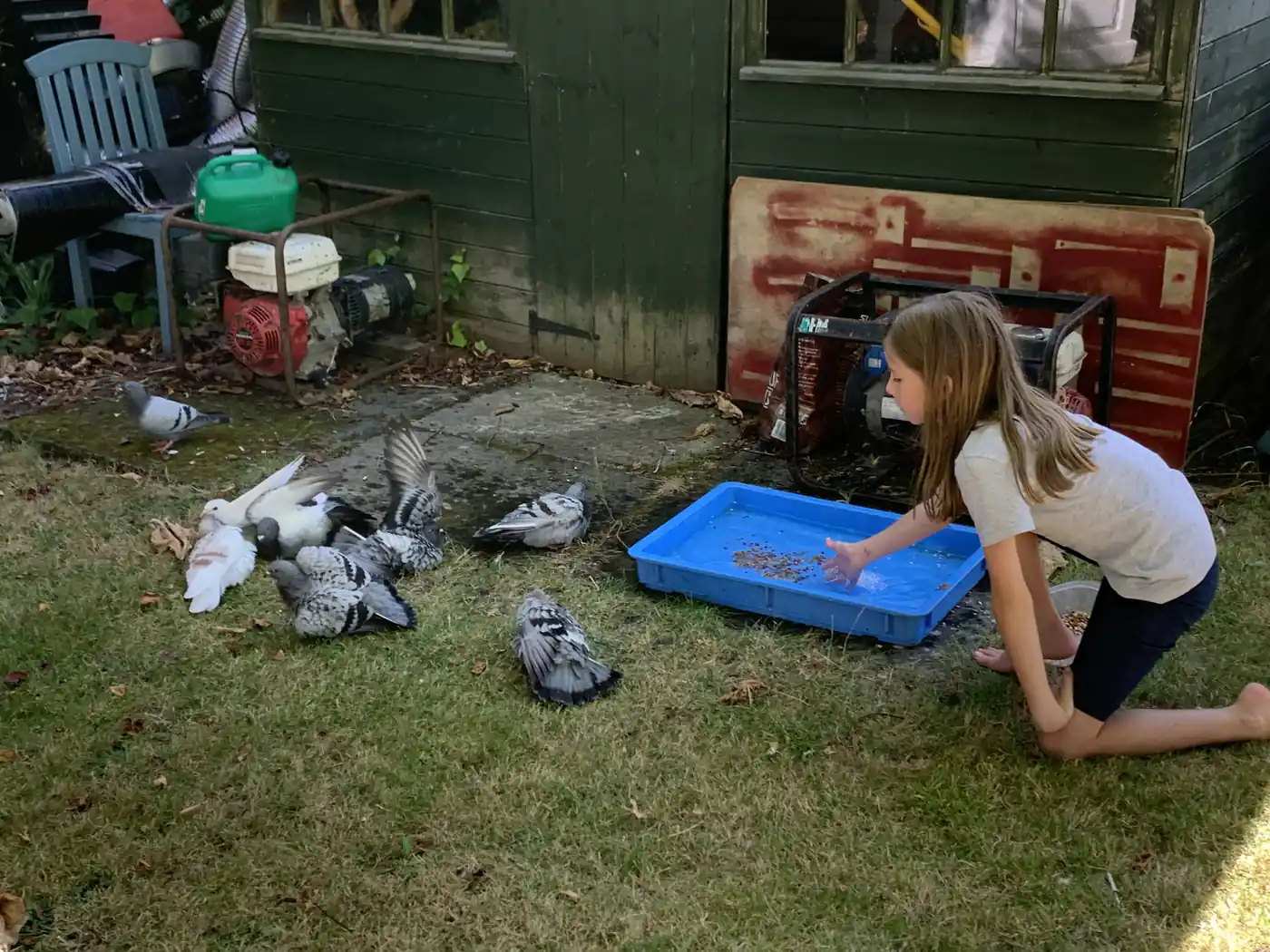
Sonnie, 2019 — already at home with pigeons. Some things start early.
This isn't just a release bird breeding programme. It's a family project. The birds will live in the garden, in full view of the house. They'll be fed by hand. They'll come when called. The children of the household are part of the taming process from the start — the more voices those birds hear consistently alongside food and calm handling, the more confident and tame they become.
Sonnie — pictured here in 2019 as a young boy, hand feeding racing pigeons at the family's previous loft — grew up around birds. He's now working in the trade. The care and understanding of animals that starts in a back garden at that age doesn't leave you. These birds will have that same environment. Kids. Garden. Grain from an open hand.
There's something irreplaceable about a child learning to hold a hand out flat with grain and have a white bird land on it. About saying "come on then" and watching a pair of wings cross the garden towards you. These aren't pets in a cage — they're birds that choose to come back. That live freely but return because the cote, the garden, and the people in it are home.
Bred to specification. Every aspect of this programme — the timing of handover at 28 days, the cross-breeding for homing ability with dove appearance, the temperament for hand taming — has been built around the exact needs of the end keeper. This is what it means to breed birds for a purpose, not a market.
Dean breeds only for people he trusts to take care of the birds.Every cross begins with Dean's eye — white, healthy, strong. A bird that looks the part and flies home.
Coming Soon · Romford · Essex · East London
A white dove release service for weddings and funerals is in development — serving Romford, Essex and East London. Built on the Burns Loft breeding programme. Birds that home. Every time.
Burns Loft · Dagenham · SE England
Young Birds & Racing Pigeons For Sale
Established racing pigeon breeder with 15+ years. Van Den Bulck, Herman Ceusters, Van Lint and Pitbull bloodlines. RPRA rung young birds available. Get in touch for current availability.